Filed under: General Health, Nutrition, Training
Lots of posts about my presenting, but I seem to be doing lots of presenting this year :).
I am honored to be presenting at the largest and longest-running fitness event in the world, the 2017 IDEA® World Convention, this July in Las Vegas.
I want to share my exclusive presenter discount with you. Save up to $100 on your registration by using code WORLD17+StPierre.
Go to www.ideafit.com/world to learn more about the two presentations I am giving:
- Pre-Conference full-day workshop: Precision Nutrition Coaching Revealed
- The Cost of Getting Lean: Is it worth the tradeoff?
I hope to see you there!
Filed under: General Health, Nutrition
I’m excited to announce that I will be giving a full-day workshop at Cressey Sports Performance in Jupiter, FL on April 9th.
==> http://ericcressey.com/cressey-sports-performance-nutrition-seminar-april-9
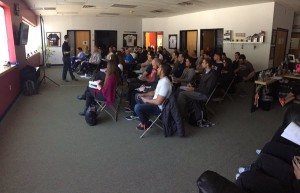
I delivered a similar full-day workshop at CSP MA last April, and it was an awesome experience.
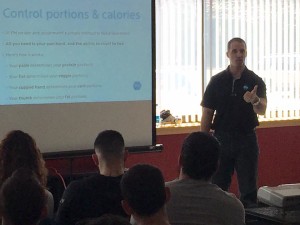
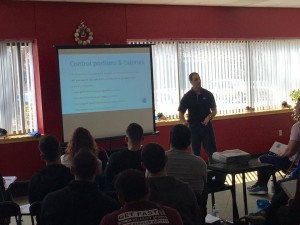
This is the kind of nutrition coaching workshop I wish I had attended 10 years ago, when I was fresh out of my nutrition undergrad. It would have accelerated my knowledge, skills, and practical application 10 fold!
I go through nutrition science, nutrition assessment and triage, making appropriate adjustments, as well as providing a coaching methodology to put it all into action.
We then take all that theory and tackle some client case studies in groups, working through and applying everything we just learned. We discuss our process and next actions, debate their merits, and come out in the end feeling well prepared to provide nutrition coaching in the real world, with real people.
Here’s a look at our agenda for the day:
8:30am — Registration
Morning Session — Laying the Foundation
- 9:00am — Human metabolism and the calorie conundrum
- 10:00am — Proteins, carbs, and fats: Why each is critical
- 11:00am — Supplements: What works, what might, and what doesn’t
- 12:00pm — Q&A
- 12:30pm — Lunch
Afternoon Session — Practical Application
- 1:30pm — How to assess and where to begin: Triaging nutrition
- 2:30pm — Controlling portions and making adjustments
- 3:00pm — Dietary adjustments for advanced fat loss and muscle gain
- 3:30pm — Breakout session: Problem solving and case studies
- 4:30pm — Closing remarks and Q&A
Sign up now to grab the early bird discount for $20-30 dollars off!
==> http://ericcressey.com/cressey-sports-performance-nutrition-seminar-april-9
Filed under: General Health, Nutrition, Training
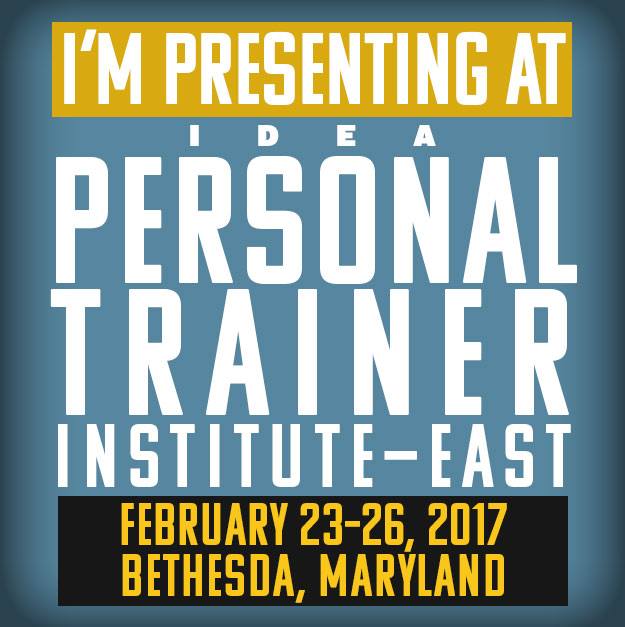
I’m honored to be presenting at the 2017 IDEA Personal Trainer Institute in Bethesda, MD, and I want to share my exclusive presenter discount with all of you.
Get $30 OFF your full or 1-day registration by using coupon code TRAINER17+StPierre.
Go to www.ideafit.com/ptrainer to learn more.
I hope to see you there!
Filed under: General Health, Nutrition
I’m very excited to announce that on Sunday, April 10th, I’ll be presenting the CSP Spring Nutrition Seminar – a full day workshop of just me! This event will take place at the Hudson, MA location. I was CSP’s first employee, and have since moved on to be the Director of Performance Nutrition at Precision Nutrition.
Here’s a look at our agenda for the day:
8:30am: Registration
Morning Session – Laying the Foundation
9:00am: Human metabolism and the calorie conundrum
10:00am: Protein: the magical macro
10:30am: Carbs: the misunderstood macro
11:00am: Fats: the mystery macro
11:30am: Supplements: what works, what doesn’t, and what might
12:00pm: Q&A
12:30pm: Lunch
Afternoon Session – Practical Application
1:30pm: How to assess and where to begin
2:30pm: Controlling portions and making adjustments
3:00pm: Dietary adjustments for advanced muscle gain and fat loss
3:30pm: Problem solving and case studies
4:00pm: Why consistency is king
4:30pm: Q&A
Location:
Cressey Sports Performance
577 Main Street, STE 310
Hudson, MA 01749
Cost:
Regular Rate – Early Bird $129.99, Regular $149.99
Student Rate – Early Bird $99.99, Regular $129
*The early bird registration deadline is 3/10/16.
Date/Time
Sunday, April 10
Registration 8:30AM
Seminar: 9AM-5PM
Continuing Education
0.7 National Strength and Conditioning Association CEUs Pending (seven contact hours)
Click Here to Sign Up (Regular)
or
Click Here to Sign Up (Student)
I’m really excited about this event, as this is the first time I outline my nutrition coaching process in its entirety in public. Space is limited and we expect this event to fill up quickly, so don’t delay on signing up!
If you have additional questions, please direct them to cspmass@gmail.com. Looking forward to seeing you there!
PS – If you’re looking for hotel information, Extended Stay America in Marlborough, MA offers our clients a discounted nightly rate. Just mention “Cressey” during the booking process in order to secure the discount. Their booking phone number is 508-490-9911.
Filed under: General Health, Nutrition, Training
I’ll be doing a YouTube interview with Sam Feltham on Thursday, April 16th at 10am Eastern. If you have any questions you want me to answer, ask them right here.
Filed under: General Health, Nutrition, Training, Weight Loss
For the first time ever, Eric Cressey’s High Performance Handbook, his most popular product, is on sale. Through this Saturday at midnight, you can get this versatile exercising resource for $50 off the normal price.
As the author of the accompanying High Performance Handbook Nutrition Guide, and having worked with Eric for 3 years, I have unique insight into the quality of his training programs. Quite frankly, they are among the best in the world. And are one of only a few that I would recommend.
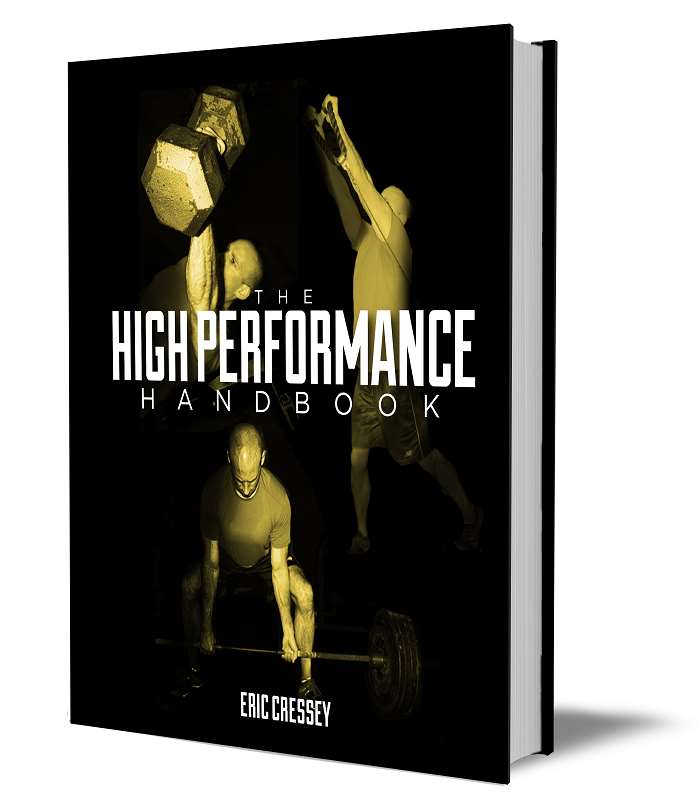
Eric went above and beyond to make sure that this resource covers all the bases. It’s not a one-size-fits-all cookie cutter program. Instead, it provides a quick and easy-to-apply – but incredibly effective – self-assessment component. This allows you to then go in a number of different ways with your training, depending on your goals, schedule, and assessment analysis. There’s even an entire chapter on modifying the program for special scenarios (over-40 lifters, overhead athletes, etc.). Eric covers it all.
Additionally, there is an insanely detailed video database that covers how to perform every possible exercise in the resource. It features over 200 exercises, each with a 30-120s coaching tutorial. That’s over three hours of videos that will be a useful resource long after you’ve completed the program.
As a final note, the High Performance Handbook also educates you along the way. You’ll learn about some of the things that are unique about your body, and how you need to manage your training accordingly. This will help you with your training for the rest of your life, not just the next 4+ months.
Here’s that sale link again:
–> The High Performance Handbook <–
And while your at it, be sure to consider the Gold Package, which is also $50 off the usual price. It includes my accompanying High Performance Handbook Nutrition Guide. It’s the most comprehensive compilation of every nutrition and health-related content I have ever put together. In fact, here is a recent email I received from a happy customer:
“Brian
I bought Eric’s handbook to help guide my personal training, and I think it’s excellent.
I went for the extra option and took your nutrition guide as well. Just to say I think it’s the most sensible, practical, no BS nutrition guide I’ve read. I’m in the sports nutrition industry and so read a lot of stuff, including all the extreme/quirky/plain odd dietary “theory” stuff. If everyone chose your guide, they would save themselves a lot of time, money and disappointment.
Just excellent Brian, thank you.
Stephen”
Thanks again for all of your continued support.
Filed under: General Health, Nutrition
My Day In The Life posts are some of my most popular, and I get requested regularly to put up more of them.
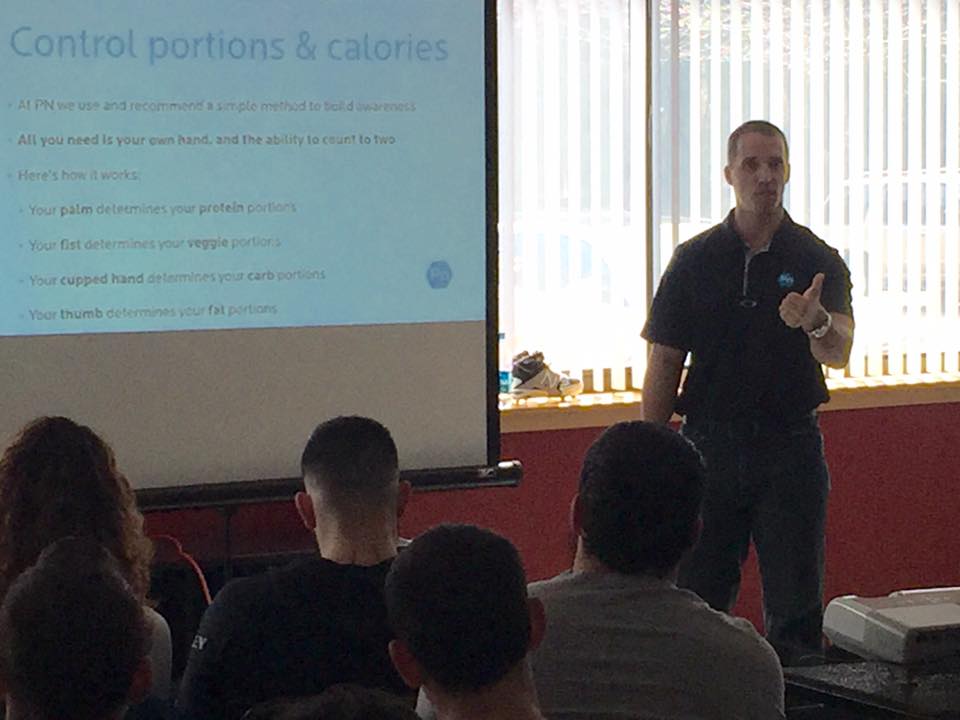
I will again emphasize that I don’t count calories or grams of anything. My intake tends to follow the PN hand-size portion guidelines, as you will see below.
Wake @ 5:30 am
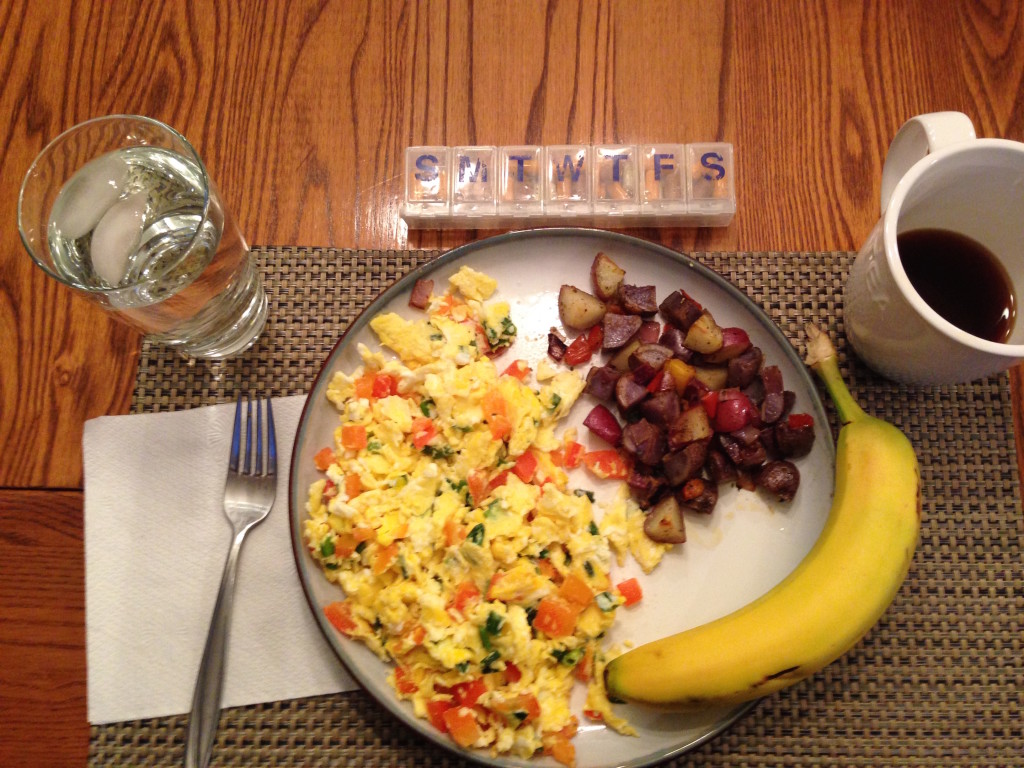
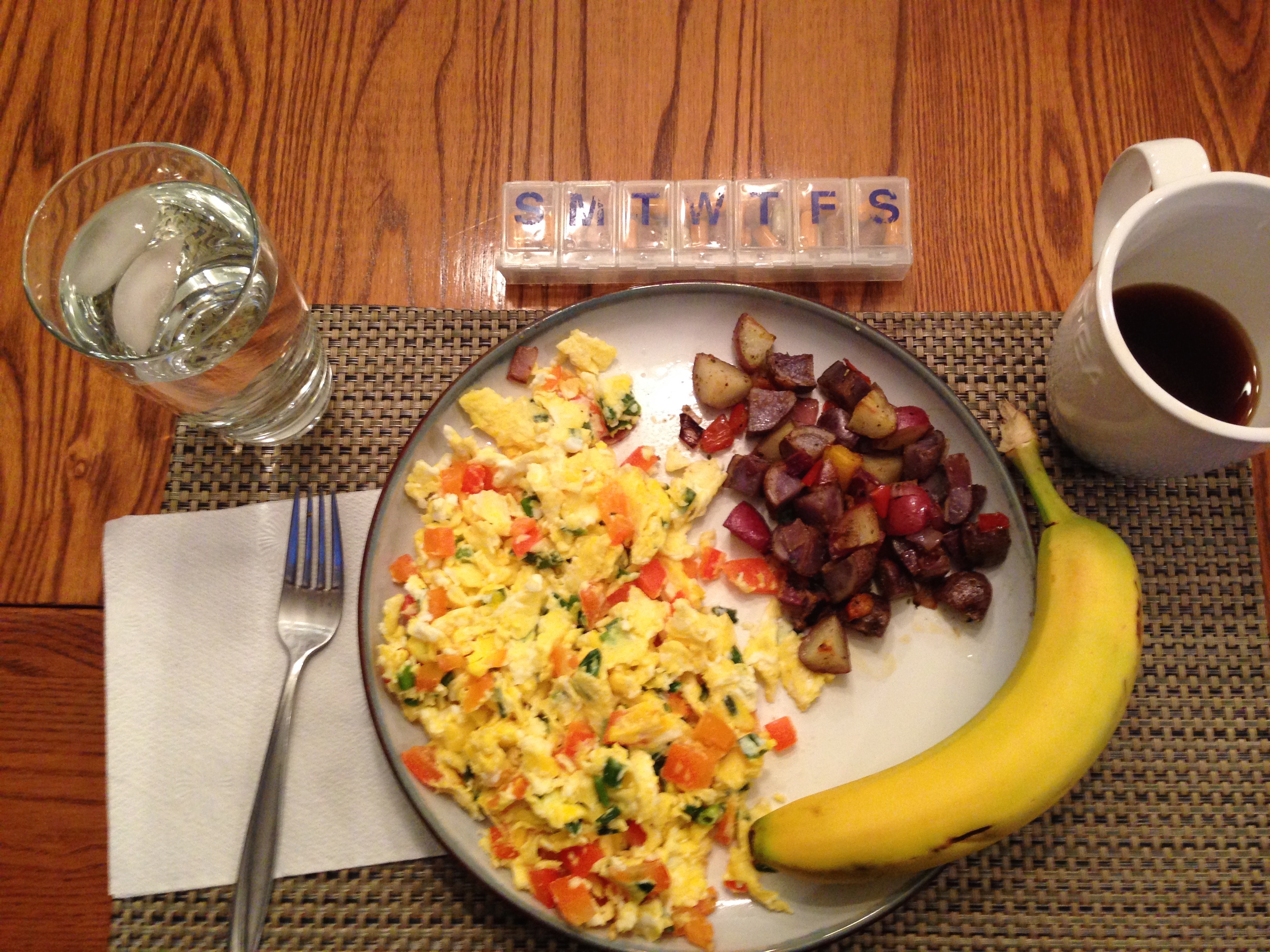
Breakfast @ 6:00 am
- 5 whole eggs (salted)
- at least 1/2 of a bell pepper (varied colors) and a bunch of scallions
- 1 handful of roasted potato mixture from previous night’s dinner (see Dinner below)
- 1 banana
- ~1/2 tbsp Kerrygold butter for eggs
- 1 glass water
- 1 multivitamin, 1 gram curcumin, 1-2 probiotics
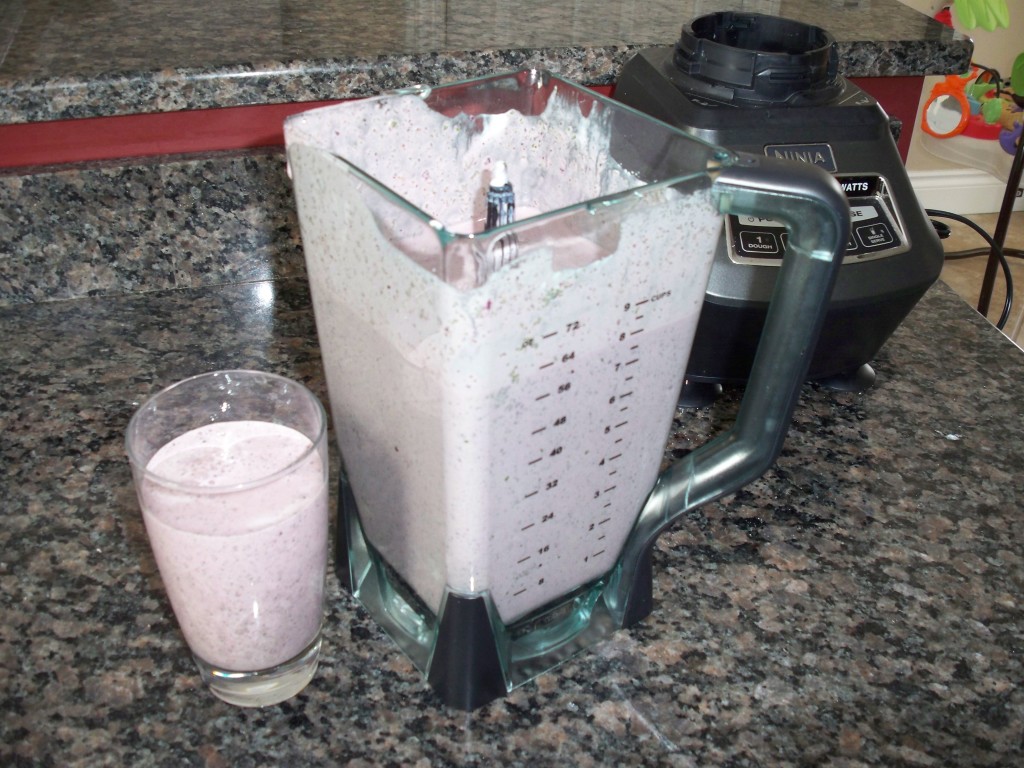
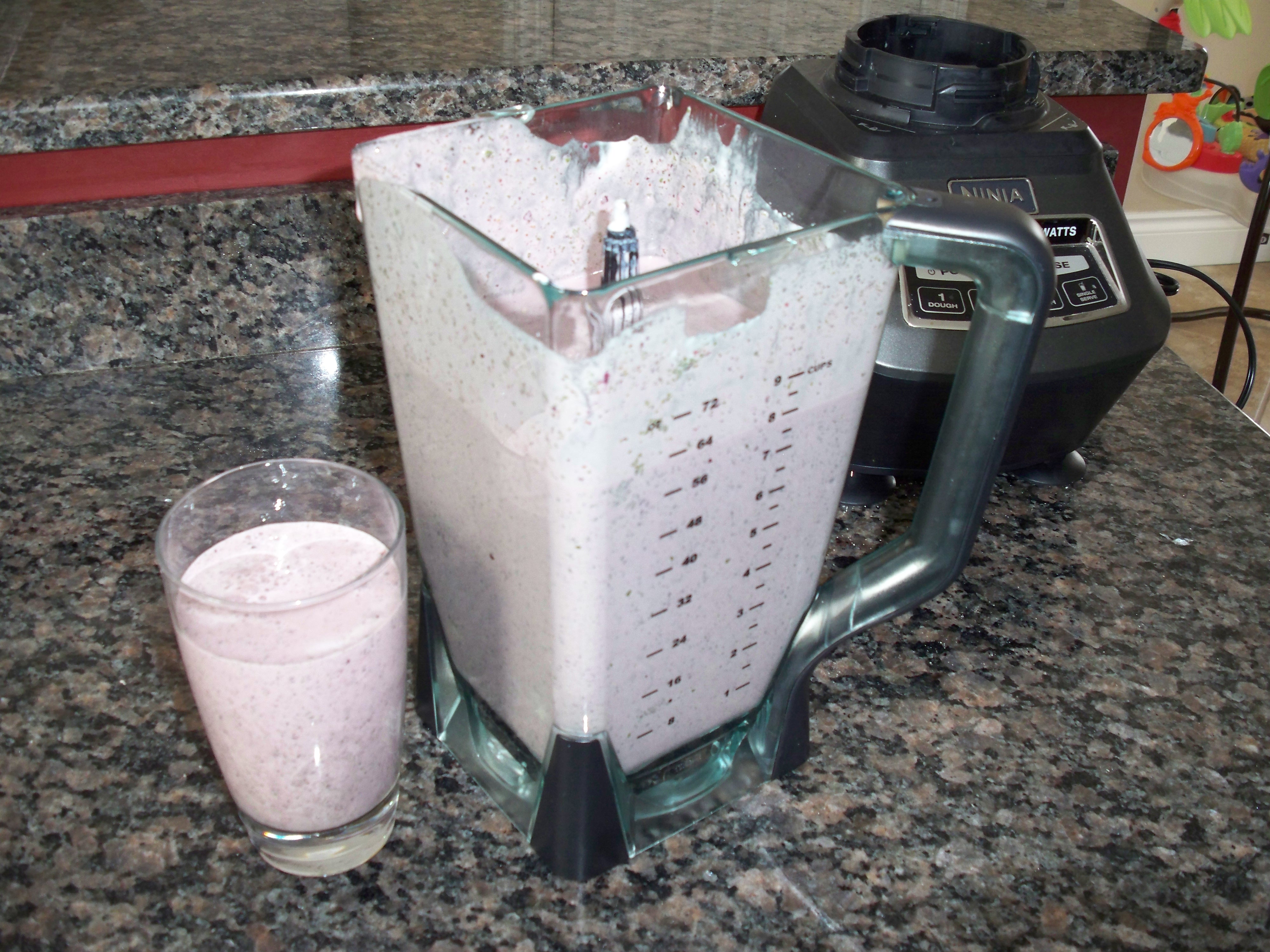
Super Smoothie @ 10:00 am
- 12-16 oz water
- 2 scoops vanilla protein powder
- 2 handfuls of baby spinach (or lately, a baby kale, baby spinach and swiss chard mix)
- 1 handful frozen blueberries
- 1 handful frozen strawberries
- ~1 tbsp chia seeds
- ~2 cups Stonyfield whole fat plain yogurt (1/2 container)
- 2-3 Athletic Greens fish oil pills
- I also usually have a cup of green tea between here and Lunch
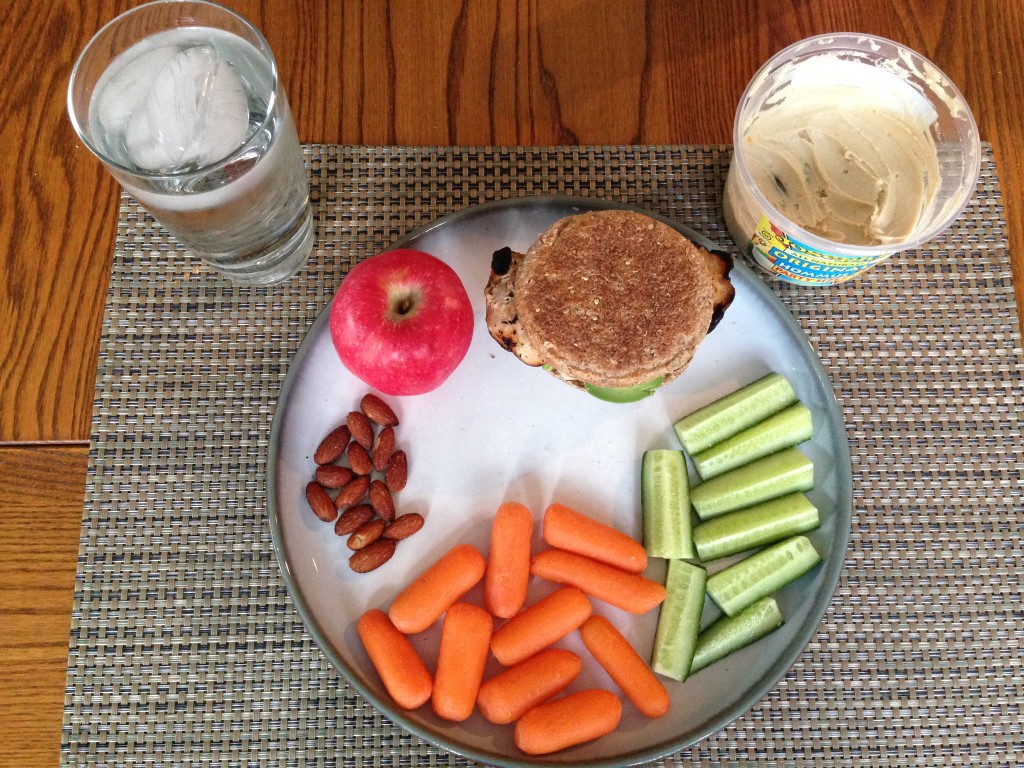
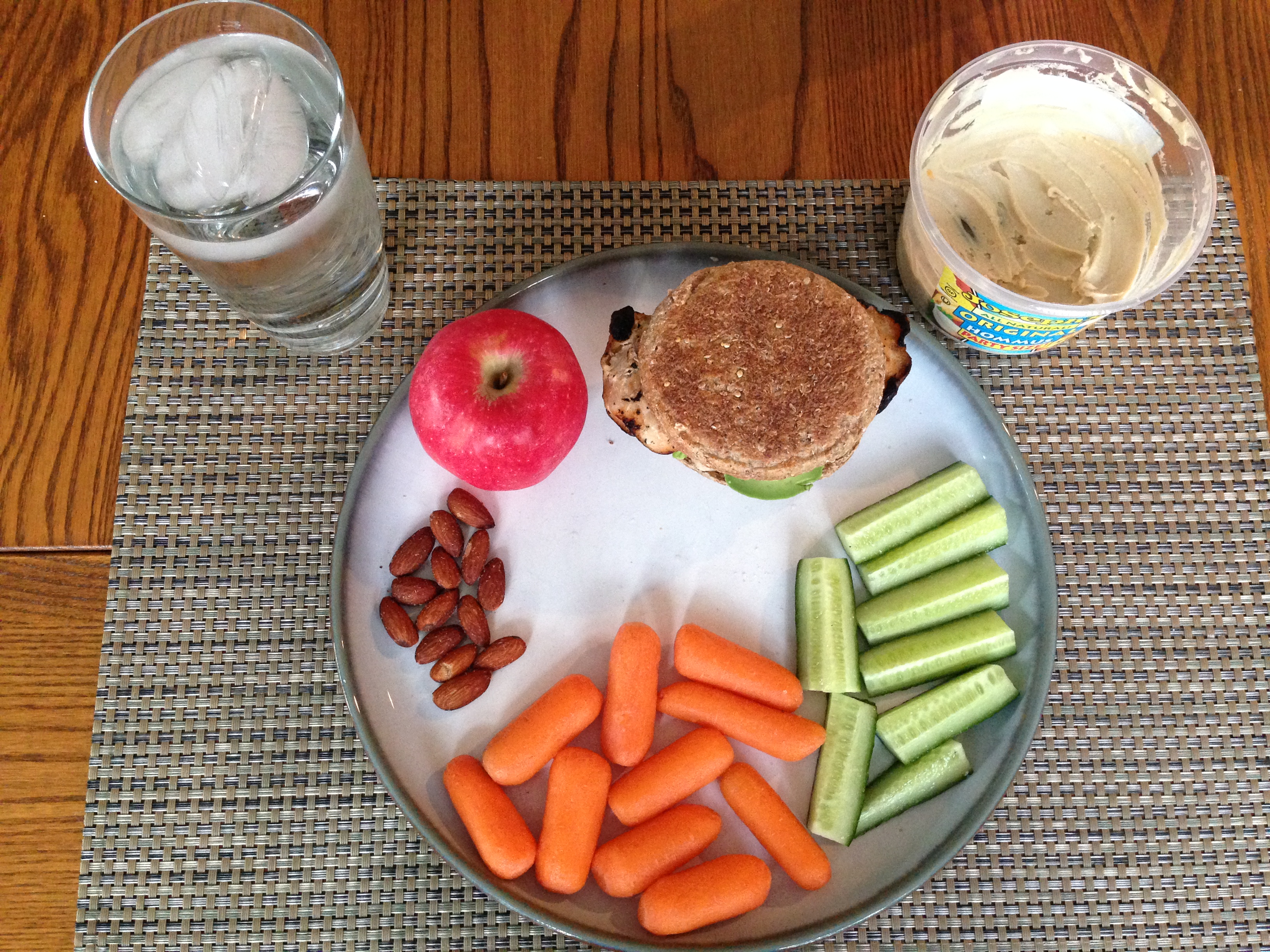
Lunch @ 2:00 pm
- 1 Ezekiel English muffin
- 1/4 of an avocado
- some dijon mustard
- 1 chicken breast
- 1 gourmet cucumber, sliced and salted
- 10 baby carrots with a little hummus
- 1/2 oz mixed nuts or almonds
- 1 apple
- 2 glasses of water
- I also usually have a cup of green tea between here and Dinner
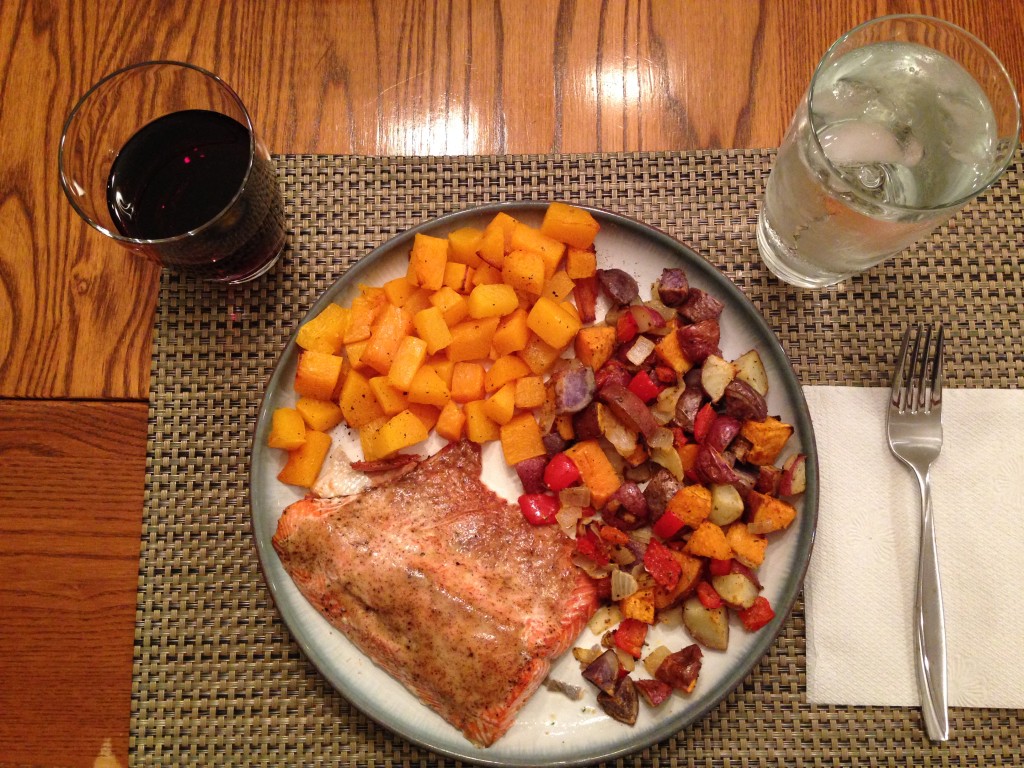
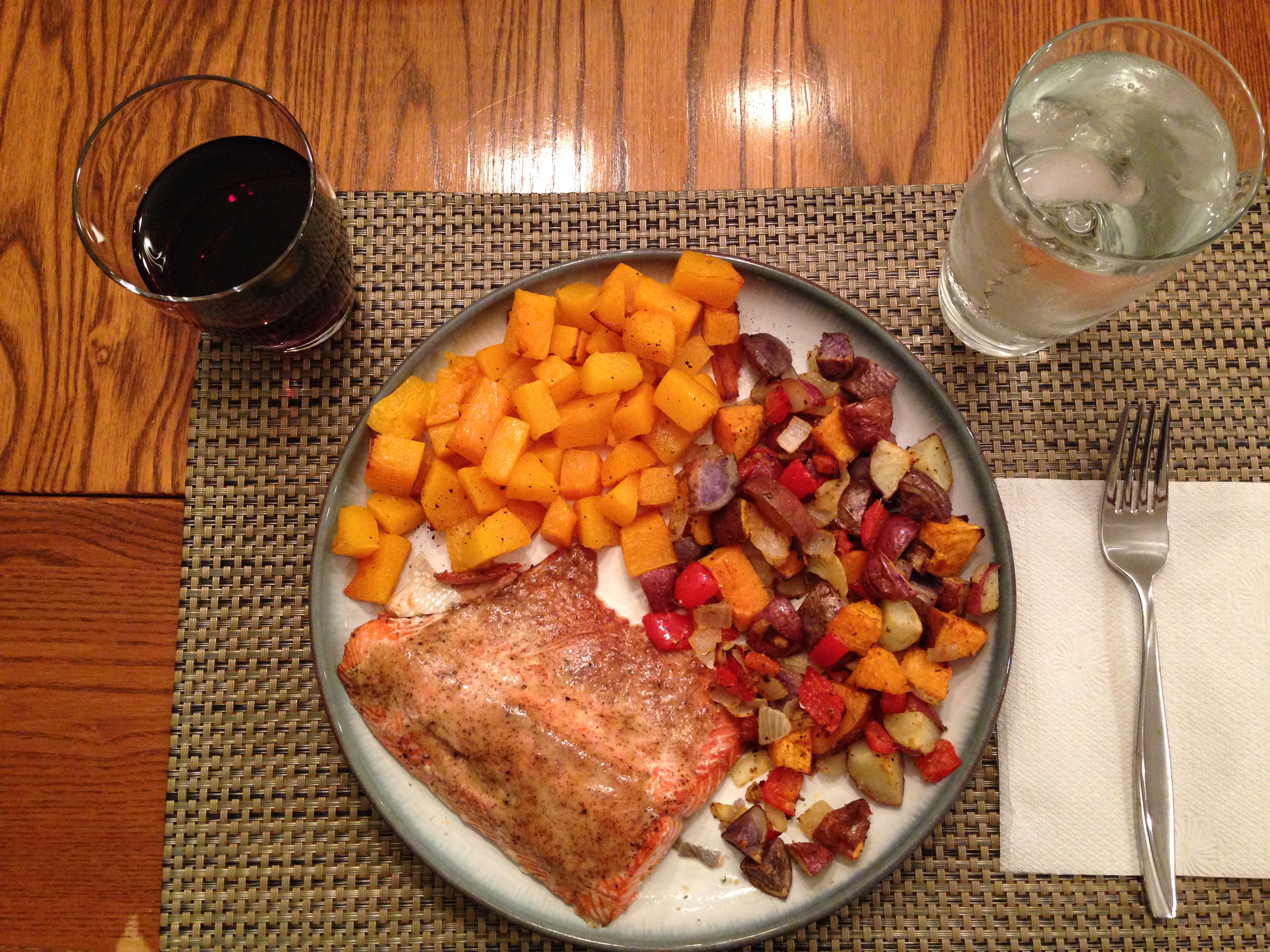
Dinner @ 6:00 pm
- ~8-10 oz wild salmon
- ~1/2 tbsp each honey, brown sugar, and dijon mustard (I use 1 tbsp of each to make the full mixture, and spread over 1 lb of salmon)
- 1-2 fists of roasted butternut squash, with extra virgin olive oil and a little salt and pepper
- 2 handfuls of roasted potato mixture: red potatoes, purple potatoes, sweet potatoes, mixed peppers, onions, with a little extra virgin olive oil and Montreal chicken seasoning
- 1 glass red wine (yes, this time it is in a juice glass, as that can go in the dishwasher)
- 2 glasses of water
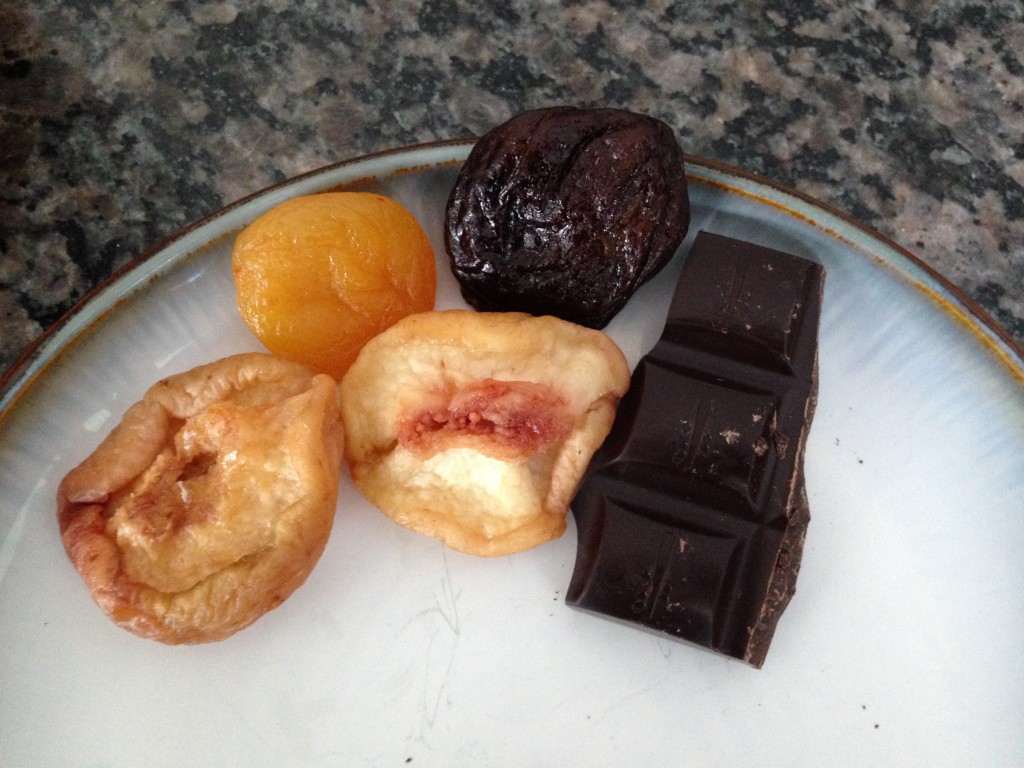
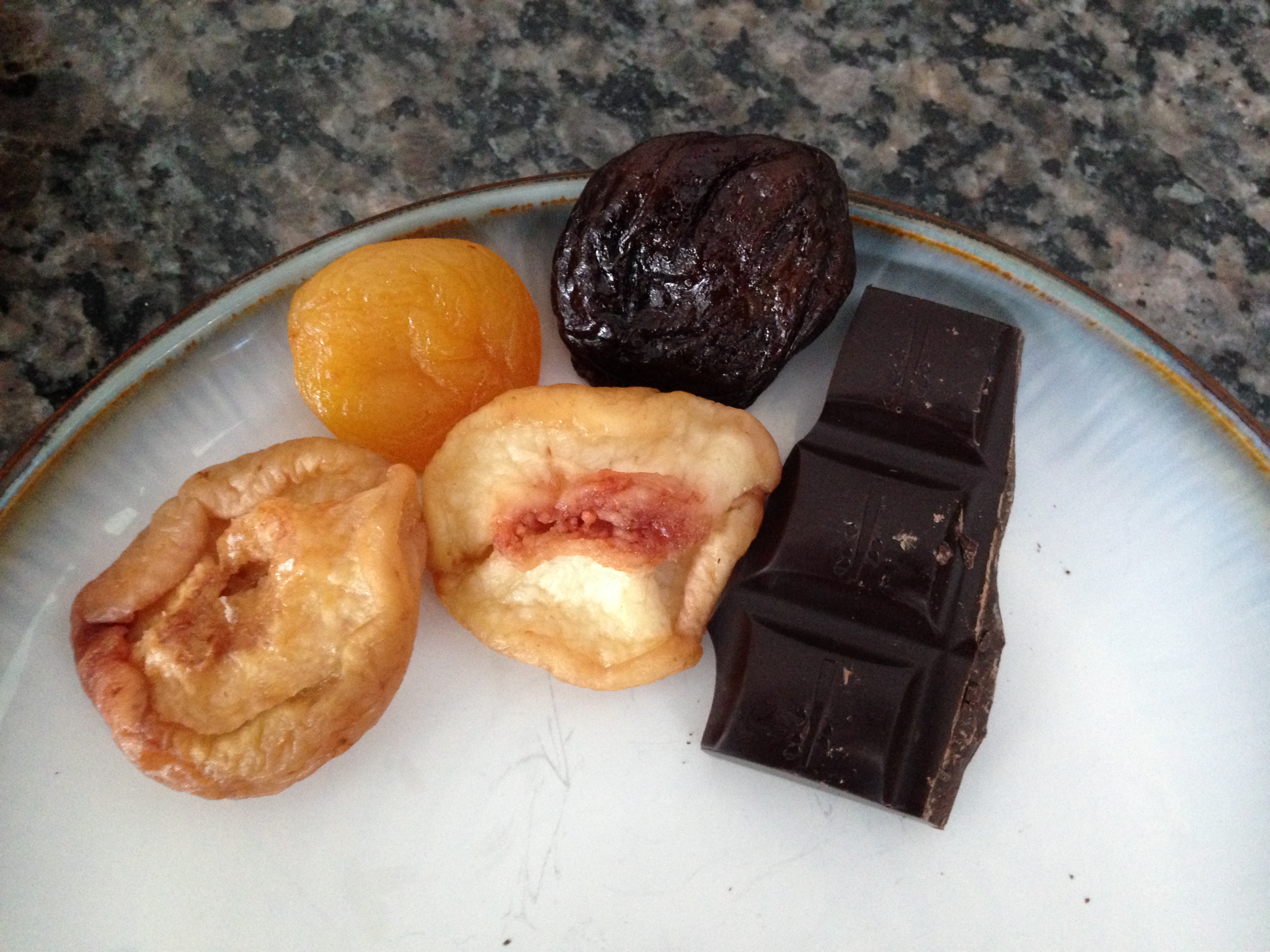
- 1 serving dried fruit and 3 squares of 88% cacao Endangered Species dark chocolate for dessert (which ConsumerLab just found to have the highest levels of flavanols of any dark chocolate tested)
I hope you get something out of seeing a snapshot of my intake. And as usual, would love to hear your thoughts, questions, and comments!
Filed under: General Health, Nutrition
I have written in the past about the health benefits of fish oil, and even about my favorite fish oil product – Athletic Greens Omega3. I will admit, it can be a little bit pricier than some other fish oils on the market. But that’s because it’s quality is second-to-none.
Well now the crew over at Athletic Greens has put together two limited time offers for Omega 3:
Buy 2 Bottles and get One Free – a 47% savings!
Buy 4 Bottles and get Two Free – a 61% savings!
Sounds like a perfect time to stock up on some fish oil!
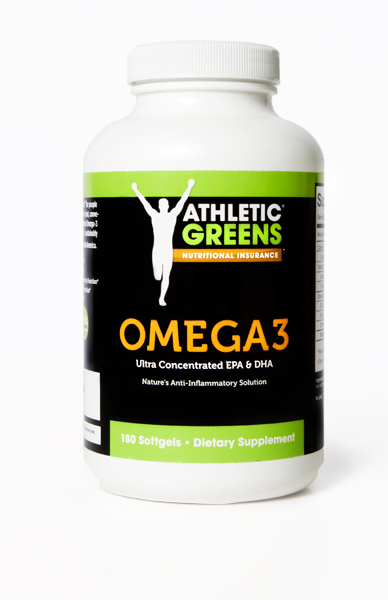
Athletic Greens Omega3
Filed under: General Health, Nutrition
A few months ago I wrote a controversial article for PN called Is nutrient timing dead?: And does “when” you eat really matter?
It generated some buzz, to say the least. The answer to the question is of course both yes and no. It all depends on the context.
Some people loved it, as they felt it provided some newfound freedom into their diet. No longer did they have to worry so much about meal timing. Now they could just focus on how much they are eating, and the quality of that food, and not stress about exactly when they are eating it.
Other people were furious, as they felt that the PW/AT distinction had come to define PN, and that we were just sweeping that away. This actually was not true. We were just adding more flexibility.
If the PW/AT distinction and framework works for you, then by all means please continue with it. YOUR results are ultimately what matters, not my theoretical meanderings. To me, that is what defines PN – that it is all about what works for YOU, not what we think will work for you. It is only the outcome that matters to us.
However, if you were someone who felt constrained by the PW/AT framework (as I did), then we offered a new set up for you (our hand-sized portion guidelines) that was equally as effective physiologically, and that many found to be much easier to implement and manage.
Neither approach is definitely right or wrong. It all depends on what works best for you.
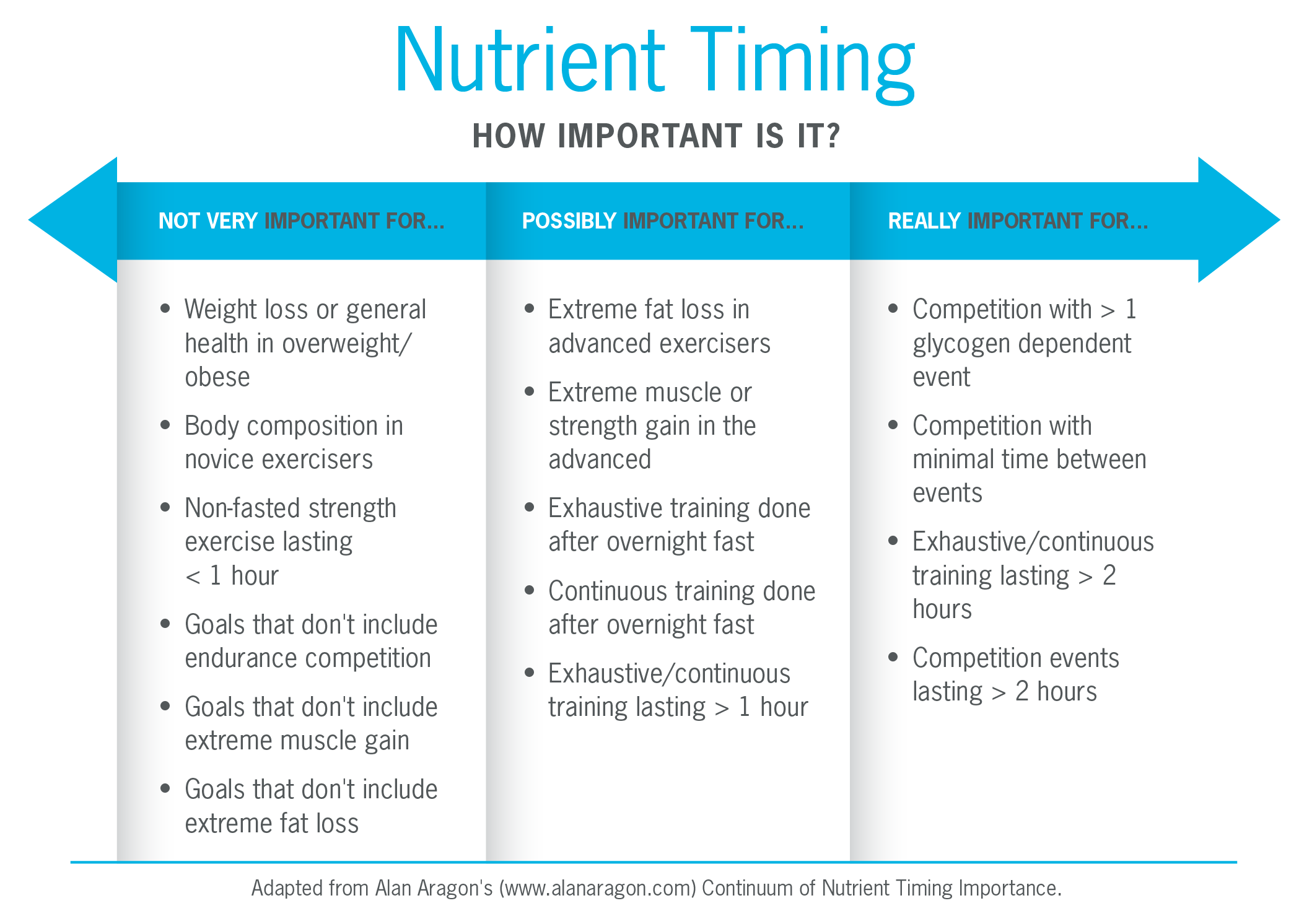
And the exact importance of timing your meals also depends on the context, as I alluded to earlier. This is especially true in respect to timing your intake around your training (which I covered here). This is a great visual depiction of what I am talking about:
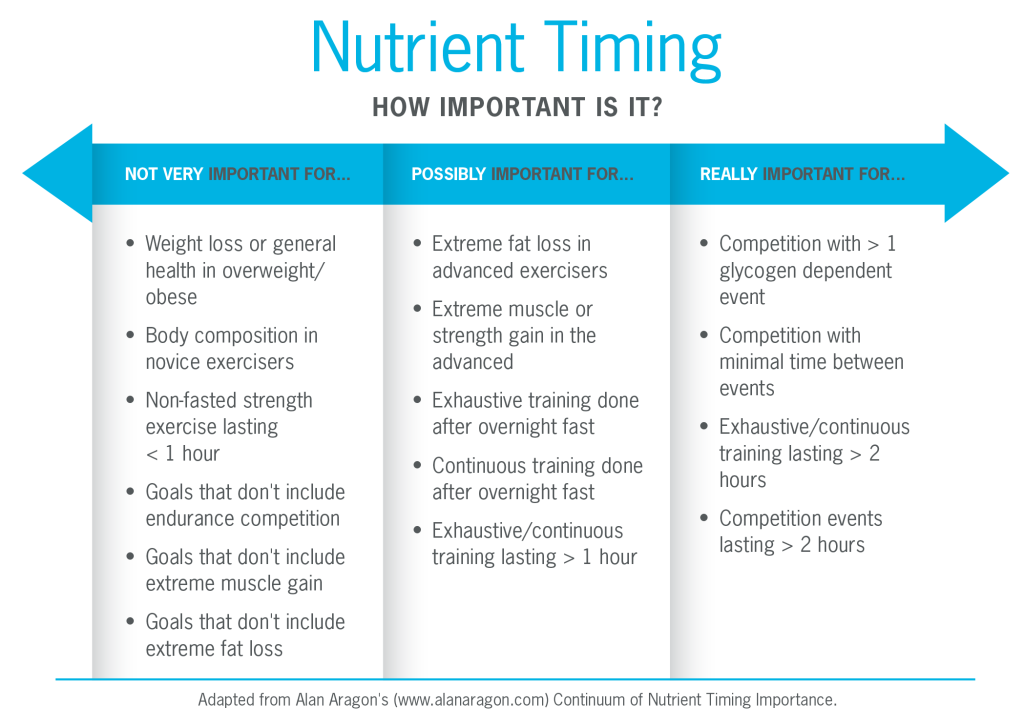
As you can see, the need to worry about timing around activity all depends the conditions of that activity, and your goals. For most of us, it is not terribly important. For others, it is far more so.
This is true even for having a protein shake post-workout. You could, as it is not going to hurt, but it isn’t really necessary in most cases. You are ok to wait until you drive home to have something. It could be a Super Shake, or it could be a whole food meal. The choice there is yours.
That was one of the most research-heavy articles I have ever written for PN, and I worked on it for weeks to get it all right. In a similar vein, Examine.com has just released an incredible new resource for people, called their Stack Guides.
They recognize that things are not always strictly black and white – that there is nuance and many shades of gray. To that end, they created these tremendous resources for people who are looking to take supplements for specific contexts – say to increase muscle mass, lose fat, or improve cardiovascular health or blood sugar control. Rather than trying to research individual supplements, they have put together resources for the best combination of options to help you reach your goals.
They are an independent, 100% transparent and unbiased source. They don’t sell any supplements, so their recommendations are all based on sound science, not them trying to make a quick buck.
Each stack also includes:
- Stacks catered not only to a goal (ie. fat loss) but also demographics (ie. for people who cannot easily tolerant stimulants)
- Nonsupplemental tips to help maximize efficacy
- Practical considerations when dealing with the components, like how to easily avoid minor side-effects of inconveniences
- Safety information on possible drug-drug interactions (although not all could be mentioned, referring to your medical doctor is still mandatory)
- Tips to help future supplement additions
- Free lifetime updates – as new research comes out, the stack guides will be updated accordingly
This will be a great resource for anyone looking to take supplements, or any fitness professional who has clients asking about what supplements to take. These resources are absolutely fantastic, and I really could have used these in my early days of training myself and coaching others – it would have saved me some serious money on supplements, and helped me give better direction to my clients. Click here to learn more.
Filed under: General Health, Nutrition, Training
A few weeks ago I wrote a comprehensive article for Precision Nutrition on appropriate nutrition protocols for working out and competing in athletic events. It was incredibly well received and gave general and specific outlines on what YOU should eat around your specific training and needs. Read it here.
Now, this was like a 4,000 word article. It went into great depth, and covered a lot of ground. But I also realize that not everyone is interested in reading 4,000 words. They just want to know what to do, and how to do it. The most practical takeaways.
So with that in mind, we came up with an awesome infographic that distills those 4,000 words down into an easy to understand and apply format. Here is a small screen shot of what it looks like:
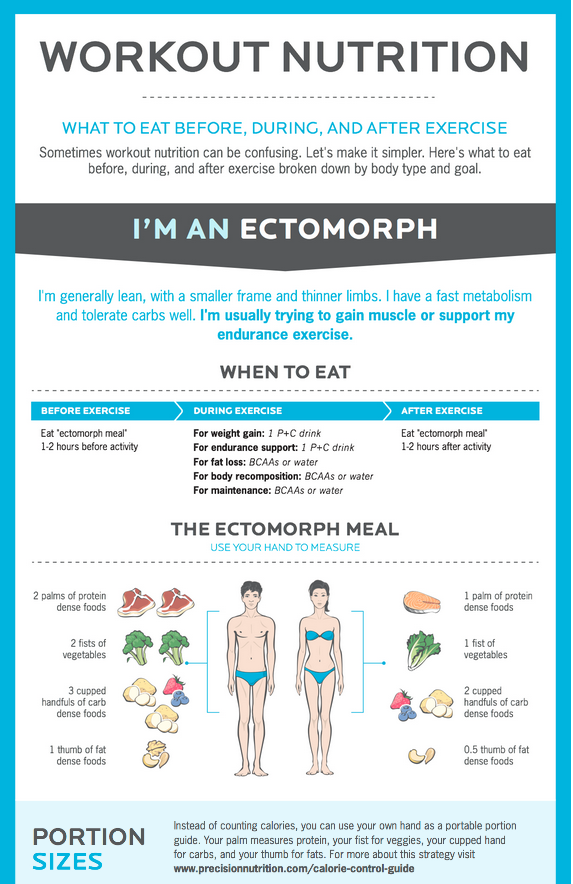
It is based both on your body type (which is a general proxy for genetics, metabolism and carb tolerance) as well as your goals (which tends to cover your activity levels). Now clearly this can’t be entirely comprehensive, but it does give you a fantastic starting point for how to eat around your training and competition to give you the best results possible.
Go here to see the full infographic.
We also provide a fully printable version of the infographic to boot!
Before I take off to Winnipeg for the weekend (I am presenting at the Canadian Athletic Therapists Association 48th National Conference), I wanted to also let you know that Mike Robertson’s fantastic Bulletproof Athlete is $50 off until midnight this Sunday.
I don’t endorse too many products, but Mike consistently puts out top-notch content, and this product is his best yet.
In case you’re unfamiliar with the product, here’s a brief overview of what you’ll find in the Bulletproof Athlete training system:
- 16-weeks of done-for-you training programs. Mike has written all of your workouts for the next 16-weeks. All you have to do is show up and train!
- 3 Programs for 1 Price! This is not a one-size-fits-all training program, so he created three workouts that you can choose from to determine which is best for you given your needs, goals, and time available to train.
- 160+ Exercises in the Video Database. Mike also coaches and cues every exercise in the program to make sure you’re doing things right. No guessing on how to perform movements – just follow along and you’re good to go!
- Weekly Nutrition and Recovery challenges. Every week you get a nutrition and recovery goal to help you build solid habits. After all, it’s not how hard you train, it’s how fast you recover that’s important!

Posted on June 15th, 2017 by Brian St. Pierre
3 Comments »